Booth Staff Training in One Day — Opening Lines, Qualifying, and the Habit of Logging
Trade show results depend less on booth design than on the quality of staff conversations. Opening lines, qualifying questions, a 30-second logging habit, and peak-hour rotation — a one-day curriculum you can run the day before opening.
Same booth, same product — the volume and quality of your leads still swing on how your staff open conversations and what they record. Teams spend heavily on booth design and then hand staffing over with a "good luck out there." This guide covers a booth staff curriculum you can run in one day before opening: the first 30 seconds, qualifying questions, the logging habit, and peak-hour rotation.
Why staff training beats booth design
Visitors spend only a few minutes at your booth. What determines the quality of those minutes isn't the graphics wall — it's the people. Untrained staff fall into three patterns:
- Waiting: standing by until a visitor speaks first — most passers-by never will.
- Leaflet dispensing: handing out materials without a conversation — most of which are found later in the venue's bins.
- Indiscriminate pitching: the same ten-minute pitch for everyone — while a real prospect walks past behind them.
The goal of training is to replace those patterns with: open first, qualify fast, always log.
Session 1 — The first 30 seconds: open with a question
"Hello, feel free to look around" closes a conversation. An open question starts one.
| Situation | Closed approach (avoid) | Open approach (use) |
|---|---|---|
| A visitor slows down | A nod and "hello" | "What are you here to look at today?" |
| A visitor studies an exhibit | "Can I explain this?" | "What equipment are you using now?" |
| A visitor offers a business card | Take the card, smile | "Thank you — what brought you to our booth?" |
The point is to start from the visitor, not the product. Ask about their situation first and the next step — qualifying — follows naturally. In training, don't have people memorize lines; run pair role-plays and have everyone say them out loud three times. Repetition sticks; reading doesn't.
Session 2 — Qualifying: read the temperature in three minutes
You can't give every visitor equal time. Three early questions reveal a lead's temperature (hot / warm / cold):
- Role: are they involved in the buying decision? ("Which team looks after this area for you?")
- Timing: is there a plan, and when? ("Is this on the roadmap this year, or more like next?")
- Situation: what do they use today and what's the pain? ("What's the most annoying part of how you do it now?")
Once you have all three, the paths diverge — book the next meeting on the spot for hot leads, record contact and interests for warm ones, politely point cold visitors to materials and move on. The classification itself is covered in our lead temperature guide.
Session 3 — Logging: within 30 seconds of the conversation ending
The asset that evaporates fastest at a trade show is conversation content. The card survives; what you talked about blurs within a day. So there is one rule: log within 30 seconds, before the next visitor.
- Keep the fields minimal: temperature, product interest, next action, one line of notes
- A tool with tap-based input instead of typing is what makes this survivable on a busy floor
- Explicitly ban "I'll write them all up tonight" — evening memory cannot reconstruct morning conversations
Why logging is what converts cards into revenue is covered in why trade show leads disappear.
Session 4 — Floor rules: peaks and breaks
- Rotation plan: concentrate people on peak windows (right after opening, after lunch) and schedule breaks in the lulls. See the booth timing strategy guide.
- Split roles inside the booth: openers near the aisle, deep-conversation staff inside — it clears bottlenecks.
- Three bans: phones out on the floor, staff chatting with each other, sitting while waiting. All three read as "please don't talk to me."
- The last 10 minutes: end each day with a team sweep of the day's records to fill gaps. Sharing one good conversation at the next morning's huddle keeps the training alive.
Training holds only if logging is easy — TagBooth
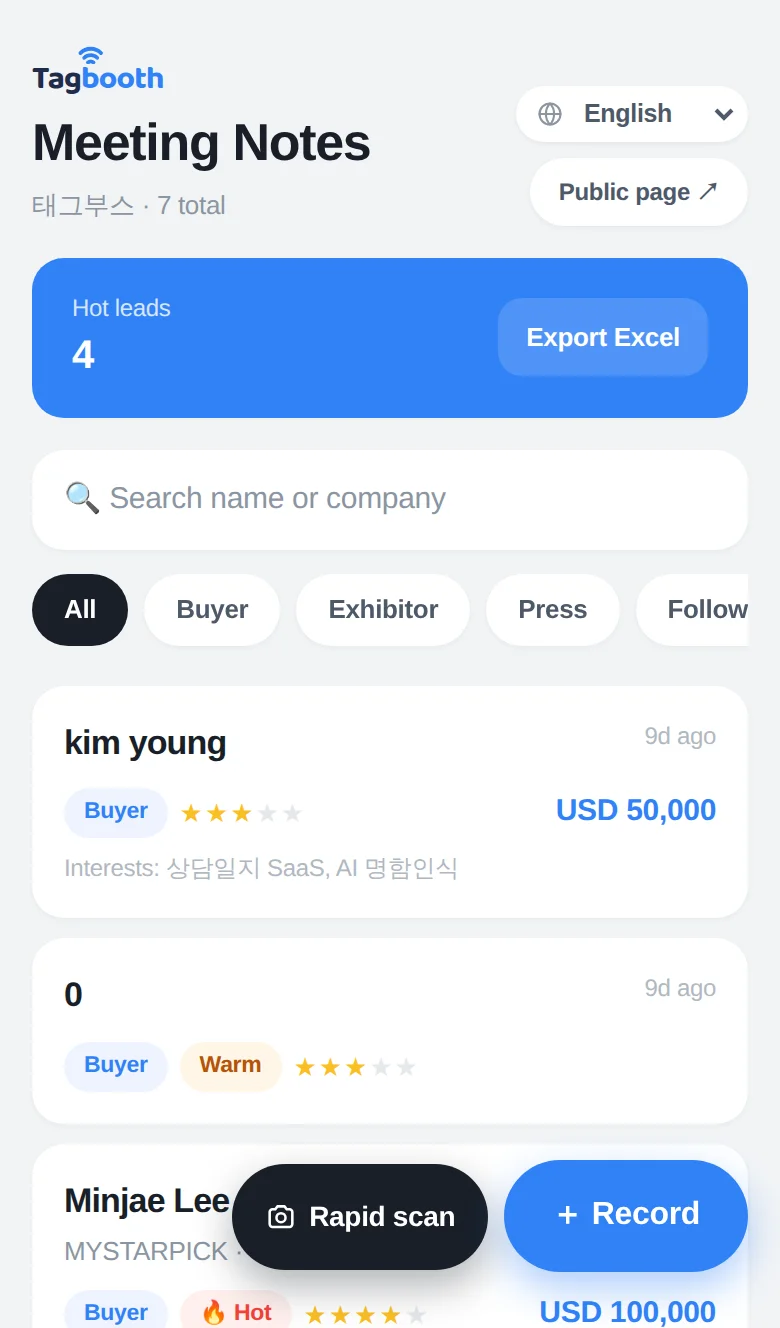
Session 3's "30 seconds" collapses if the tool is heavy. With TagBooth, one tap on the tag opens the staff logging screen; temperature, star rating, visitor type, and interests are entered as one-touch chips — the only thing you type is a number. Business cards are captured with a single photo, with AI reading even mixed Korean/English cards.
As records accumulate, the event report draws daily and hourly charts and the temperature distribution automatically — the evidence base for your rotation plan and your next event. Try the logging screen in the demo without signing up; the full flow is in how it works.
FAQ
How much time should training take?
Half a day (3–4 hours) the day before opening covers this curriculum. The core isn't lecturing — give more than half the time to role-play practice on openers and qualifying. During the show, a ten-minute morning huddle reviewing the previous day keeps it working.
Do temp staff and agency hires need the same training?
Split the roles. Deep conversations that need product knowledge belong to your own team; give external staff Session 1 (opening) plus guidance and flow management. But the logging rule — 30 seconds, tap-based input — applies to everyone, or your data will have holes exactly where it matters.
What if staff keep skipping the logging?
Check the tool before blaming the people. If a record takes more than a minute, no rule will survive the floor. Cut input down to taps, and make the end-of-day sweep a team habit where the day's record count is visible to everyone. Team routine outlasts individual pressure.
Don't opening lines differ across cultures?
They do. For overseas shows, include local greeting customs and business card etiquette in the training. But the principle — start from the visitor's situation, not your product — travels everywhere. Overseas preparation as a whole is covered in the overseas expo checklist.