International Trade Show Checklist — From Booth Booking to Post-Show Follow-Up
A complete trade show checklist organized as a timeline — D-90, D-30, D-7, on-site, and post-show. Covers booth booking, grant paperwork, lead capture prep, and the 48-hour follow-up.
An international trade show is not a trip — it is a sales operation with flights attached. Yet most preparation effort goes into the logistics of getting there (booth build, travel, shipping), while the work that actually produces results — lead capture and follow-up — gets postponed until the week before departure. Here is the short version: run your preparation as a five-stage timeline — D-90 (booking and goals), D-30 (materials and staffing), D-7 (final checks), on-site (recording and daily review), and post-show (follow-up and reporting) — and decide how you will capture leads no later than D-30. This guide walks through each stage and the items teams most often miss.
D-90 — Book the Booth and Set Numeric Goals
Three months out feels early, but popular shows sell out prime floor space quickly, and funding programs have fixed application windows. Three things belong in this stage.
First, confirm your booth. Book through the organizer's official channel and verify location, size, and what is included — power, internet, furniture. Early-bird pricing and good corner positions are only available now.
Second, check for funding and support programs. In many countries, trade promotion agencies, regional governments, and industry associations subsidize participation in overseas exhibitions. These programs typically open applications months in advance, and most come with a condition: a results report after the show, covering meeting counts, discussed deal values, and contracts in progress. Find out exactly which data points the report requires now — that list becomes your on-site recording checklist later.
Third, set goals as numbers. Not "meet lots of buyers," but "60 meetings, 15 hot leads, X in discussed pipeline value." Numeric goals make it possible to work backwards to staffing levels, interpreter needs, and how many pre-booked meetings you should aim for — and they make the post-show review honest.
D-30 — Materials, People, and Your Lead Capture Method
One month out is the production stage. Printing, translation, and hiring all have lead times, and options narrow fast once this window closes.
- Brochures and catalogs: Produce versions in the languages your buyers actually read, not just your home language. Decide print quantities with luggage weight and customs in mind, and prepare a digital brochure page as a backup so you never "run out" of materials mid-show.
- Business cards: Order plenty in English (or the show's business language). More importantly, decide now how collected cards will be processed. The plan to "sort the card stack after we get home" fails almost every time — cards without meeting context are nearly worthless.
- Interpreters and local staff: Book interpreters through a local agency or your trade promotion office. Be explicit about the role: interpretation only, or interpretation plus meeting recording? The answer determines how much training they need before day one.
- Lead capture method: Choose it now — paper meeting logs, a spreadsheet, or a dedicated tool — and predefine the fields: products of interest, follow-up actions, lead temperature, deal value. The data points your funding report requires (from D-90) should map one-to-one onto these fields.
- Pre-booked meetings: Use the organizer's matchmaking program and notify existing contacts of your booth number. Exhibitors consistently report that pre-booked meetings convert better than walk-by traffic.
D-7 — Field Kit and a Recording Rehearsal
One week out is for verification, not creation. Nothing new should be produced; the job is finding what is missing.
- Field kit check: Brochures, cards, samples, power strips and plug adapters (verify local voltage and socket type), tape and scissors, basic medicine — run it as a written checklist, not from memory.
- Internet and power: Confirm whether the booth includes wired internet, what venue Wi-Fi is like, and your roaming or local SIM plan. If you chose a digital lead capture tool, verifying on-site connectivity is a mandatory checklist item.
- Recording rehearsal: Before departure, every team member records one full mock meeting with the actual tool: capture the card, tap products of interest, enter a deal value, check a follow-up action. Time it. Teams that skip this rehearsal typically lose most of day-one morning's meetings to blank records.
- Time zones and schedule: Publish the booth shift schedule and the daily evening lead review in everyone's calendar, in the event's local time zone.
On-Site — Divide Roles and Review Leads Every Evening
The most common on-site failure mode is simple: everyone talks, nobody records. Two rules prevent it.
First, divide roles. Assign meeting owners, demo staff, and a recording owner — but the most accurate pattern is that whoever held the meeting records it themselves, within 30 seconds of the visitor leaving. Give interpreters a ten-minute walkthrough of the recording method on the first morning; if the method is too complex for them, that time slot's meetings simply vanish.
Second, hold a daily evening lead review. As a team, go through the day's meetings: confirm hot/warm/cold temperatures, fill in missing notes, and list every promised follow-up (quotes, samples, spec sheets). Twenty minutes is enough, and those twenty minutes determine how fast your post-show follow-up moves. When recording deal values, always record the currency alongside the number — local currency, USD, and home-currency conversions mixed in one column make post-show totals meaningless.

Post-Show — The 48-Hour Follow-Up and the Results Report
It is a common observation across the exhibition industry that a large share of trade show leads are lost simply because nobody follows up. After the show, there are only two jobs, and both are about speed.
Send the first follow-up within 48 hours. Start with hot leads, and send individual emails that attach exactly what was promised in the meeting. If products of interest and follow-up actions were recorded on-site, the email practically writes itself. Schedule sends to land during the recipient's business hours.
Submit the results report. If you participated through a funding program, compile meeting counts, discussed deal values, and contracts in progress in the agency's required format. If currencies and timestamps were recorded cleanly on-site, this is a simple aggregation task; if not, it becomes a painful reconstruction from card stacks and memory. Finally, write an internal review — results versus goals, booth location and staffing assessment, and whether to return next year. That document makes next year's D-90 dramatically easier.
Checklist Summary by Stage
| Stage | Key Tasks | Owner |
|---|---|---|
| D-90 | Book booth, apply for funding programs, confirm required report data, set numeric goals | Founder / marketing lead |
| D-30 | Produce brochures, order cards, book interpreters, finalize lead capture tool and fields, pre-book meetings | Marketing owner |
| D-7 | Field kit check, verify internet and power, full-team recording rehearsal, publish shift schedule | Operations owner |
| On-site | Run role assignments, record within 30 seconds of each meeting, daily evening lead review | Entire booth team |
| Post-show | Follow up hot leads within 48 hours, submit results report, internal review | Sales owner / lead |
Four Things Teams Most Often Miss
- Interpreter training: Interpreters have never seen your tools. If recording requires typing long notes in your company's format, they will stop recording — and every meeting they handled disappears with them.
- A card-processing plan: "We'll sort them at home" is not a plan. Decide at D-30 how cards get digitized the moment they are received.
- Currency confusion: A deal value without a currency label — was that MYR, USD, or a home-currency estimate? — turns your pipeline total into guesswork.
- Report data definitions: If you do not confirm the required report fields at D-90, you will discover after the show that nobody recorded the one number the agency asks for.
Collapsing Half This Checklist into One Tool
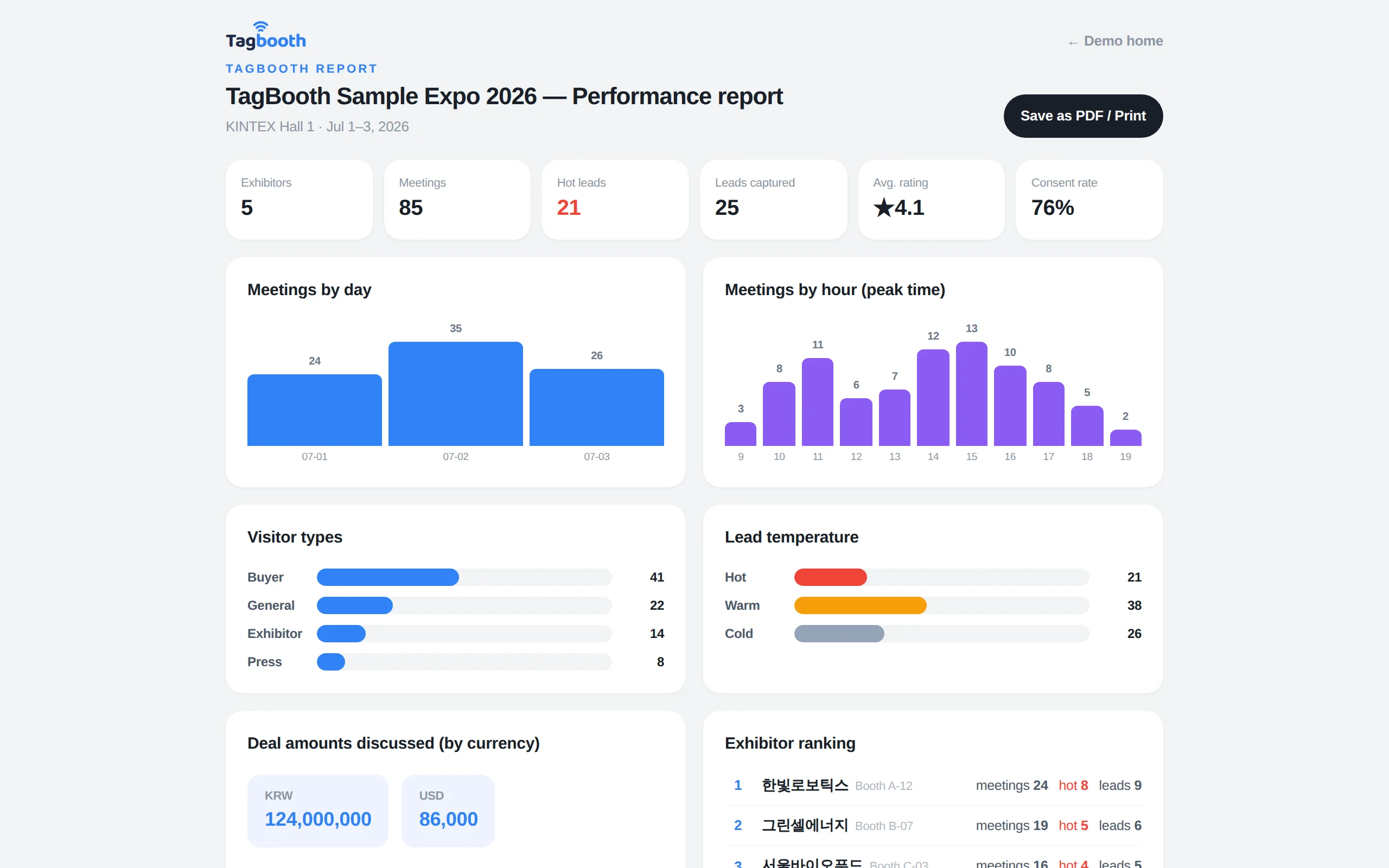
Much of the work from D-30 onward — the lead capture tool, interpreter training, currency handling, report data — can be solved with a single tool choice. TagBooth is a trade show lead capture tool that opens from a QR or NFC tag on your booth. It runs in the browser with no app install, and predefined chips (tap-to-select buttons) let staff record a full meeting in about 30 seconds. The interface supports 10 languages — including English, Arabic, German, Simplified and Traditional Chinese, Japanese, Spanish, Thai, and Vietnamese — so local interpreters and hired staff work in their own language with almost no training. Deal values are recorded in any of 8 currencies (USD, EUR, JPY, CNY, KRW, MYR, SGD, VND), every entry is timestamped in the event's local time zone, and when the show ends you can export a results report as PDF or Excel — formatted for submission to funding agencies. The same tag shows visitors your brochure page. Try it with no setup on the demo page, or see the full workflow in how it works.
FAQ
How far in advance should we start preparing for an international trade show?
Start at least 90 days out. Booth applications and funding program windows close early, and long-lead-time work — brochure production, interpreter booking — needs to finish by D-30. For popular shows, prime booth space can sell out six months or more in advance.
What changes if we participate through a funding or support program?
Funding programs from trade promotion agencies typically reduce booth and travel costs, but most require a results report after the show covering meeting counts and discussed deal values. Confirm the exact required data points when you apply, and make sure your on-site recording method captures every one of them.
Can we ask interpreters to record meetings as well as interpret?
Yes, if the recording method is simple enough. Interpreters are unfamiliar with your internal tools, so favor tap-to-select recording over free-form typing, and run a ten-minute walkthrough on the first morning. A tool whose interface works in the interpreter's own language cuts the training burden even further.
Which currency should we use when recording deal values?
Record the currency actually discussed in the meeting — usually the local currency or USD — and always label it explicitly. Convert to your home currency once, at reporting time. Numbers recorded without currency labels make post-show pipeline totals impossible to trust.
Why is 48 hours the benchmark for post-show follow-up?
Because memory fades and competitors move. Within days, buyers forget the details of your booth conversation, and the first personalized follow-up in their inbox usually wins the reply. Start with hot leads and attach exactly what was promised during the meeting.