Hot, Warm, Cold — A Practical Guide to Lead Temperature at Trade Shows
How to classify trade show leads as hot, warm, or cold, with booth-ready BANT questions, a follow-up playbook per temperature, and the mistakes that break it.
If you collect 100 leads at a trade show and send all 100 the same follow-up email, you have effectively thrown away the advantage of having met them in person. Lead temperature classification — sorting every conversation into hot (ready to buy), warm (interested, no timeline), or cold (just researching) — is the simplest qualification system that actually survives the chaos of a booth, and it only works if you score each lead within about ten seconds of the conversation ending. This guide covers the criteria for each temperature, a booth-adapted version of BANT questioning, a follow-up playbook per temperature, and the three mistakes that quietly break the whole system.

What exactly separates hot, warm, and cold?
The boundary between temperatures is not how enthusiastic the visitor seemed. It is where they are in their buying journey, established by facts that surfaced during the conversation. Feelings vary from rep to rep; facts do not.
| Temperature | Definition | Signals you actually heard |
|---|---|---|
| Hot | Concrete budget and purchase timeline, and the visitor is a decision-maker or sits directly in the approval chain | "We need this deployed by Q3," "Can you send a quote this week?", a title with purchasing authority |
| Warm | Clear interest and a real need, but timeline and budget are still undefined | "This could fit our workflow," "Let me review the materials," detailed product questions with no mention of timing |
| Cold | Information-gathering stage; no purchase intent confirmed | "Interesting, didn't know this existed," picks up a brochure and moves on, competitors, students, general attendees |
One caveat worth stating plainly: cold does not mean worthless. Cold means not worth sales time right now. Cold leads belong in a low-cost nurture channel — a newsletter, a quarterly update — where some of them will warm up when budgets open or priorities shift. Temperature is a priority ranking, not a verdict.
How do you qualify a lead in a five-minute booth conversation?
BANT — Budget, Authority, Need, Timeline — is the classic qualification framework, but it was built for discovery calls, not for a standing conversation next to a product display. At a booth you need a lighter version: the same four checkpoints, folded into natural conversation so it never feels like an interrogation.
| BANT element | Booth-friendly question | What a hot answer sounds like |
|---|---|---|
| Need | "How are you handling this today?" | Specific frustration with their current approach |
| Timeline | "If you were to move on this, what timeframe are you looking at?" | A concrete quarter or month |
| Budget | "Roughly what range would a project like this need to fit?" | Names a range, or asks for pricing directly |
| Authority | "Who usually owns this kind of decision on your side?" | "That would be me," or an offer to introduce the decision-maker |
You rarely need all four. Need plus Timeline is usually enough to place a lead: a concrete timeline pushes toward hot, clear need without a timeline lands at warm, and neither means cold. What matters just as much as the label is capturing the one sentence that justified it — "budget approved for Q3," "not the decision-maker, gathering info for a report." That note becomes the opening line of your follow-up email.
Why does the rating have to happen within ten seconds of the conversation?
Picture a rep who talks to thirty visitors in a day, then sits down that evening with a stack of business cards to assign temperatures. By then, the eager buyer from 10 a.m. and the polite browser from 3 p.m. have blurred together. Memory researchers call this interference — similar experiences stacked back to back overwrite each other — and few environments produce it as reliably as a booth: the same pitch, in the same spot, to a stream of similarly dressed people.
Immediately after a conversation, every input you need is still intact: the visitor's last question, their reaction to pricing, the way they handed over their card. At that moment, assigning a temperature takes ten seconds and is close to accurate. Six hours later, ten minutes of effort will not recover the same precision.
The practical implication: the bottleneck is not judgment, it is tooling. If recording a lead means opening a laptop and finding the right spreadsheet row while the next visitor is already waiting, the ten-second rating simply will not happen. The capture step has to be faster than the excuse to skip it.

What should follow-up look like for each temperature?
Classification is only useful if it changes what happens after the show. Contact timing, owner, content, and goal should all differ by temperature.
| Hot | Warm | Cold | |
|---|---|---|---|
| First contact | Within 24–48 hours of the show closing (during the show if possible) | Within one week | Within two weeks, batched |
| Owner | Sales rep, one-to-one | Sales or marketing, personalized email | Marketing, newsletter enrollment |
| Content | The quote or proposal promised at the booth, plus a meeting proposal | Detailed product materials, relevant case studies | Company overview, periodic updates |
| Goal | Booked meeting, quote stage entered | Move the lead up to hot | Stay on the radar until timing changes |
Think of it in reverse: if you walked away with ten hot leads, your sales team's first 48 hours belong entirely to those ten. Warm leads get the following week; cold leads go to automation. Without temperature data, that prioritization cannot exist — and the default outcome is one generic blast to everyone, which converts the hot leads no better than the cold ones.
What are the most common mistakes teams make?
Marking everything hot
The most frequent failure mode. Reps under "don't lose this one" pressure tap hot for anyone friendly, and the team comes home with 70 hot leads out of 100. Seventy hot leads is the same as zero — the ranking has collapsed. Fix it with a fact-based bar agreed before the show, such as "hot requires at least two of budget, timeline, and authority confirmed," and expect hot to be a minority of total conversations. If it isn't, the bar is too low.
Recording a temperature with no supporting note
A list that says only "hot" tells the follow-up owner nothing about why. A single line — "targeting September rollout, is the purchasing lead" — changes the subject line and first sentence of the follow-up email. The temperature sets the priority; the note writes the message. They only work as a pair.
Classifying everything after the show
"Focus on conversations now, sort later" sounds disciplined, but the memory-interference problem above means post-show classification is largely guesswork dressed up as data. Worse, batch classification usually happens days after the show — by which point the 24–48 hour window for contacting hot leads has already closed.
How do visitor types combine with temperature?
Temperature alone is sometimes not enough, because two "hot" leads can require completely different handling — a buying prospect and a fellow exhibitor proposing a partnership are not the same pipeline. Recording visitor type — buyer, general attendee, exhibitor, or press — alongside temperature completes the follow-up matrix.
- Buyer + hot: top priority; a named sales rep, quote or meeting proposal within 48 hours.
- Buyer + warm: the standard nurture track; materials now, a check-in one to two weeks later.
- Exhibitor + hot/warm: route to partnerships or business development, not sales.
- Press: skip temperature entirely — there is no buying journey to score. Press contacts get their own track: press kit, product images, and an introduction to whoever owns communications.
Forcing press or exhibitors onto the temperature scale usually files them under cold, where they get ignored. Segment by type first; apply temperature seriously only to buyers.
Making the ten-second rating realistic — TagBooth
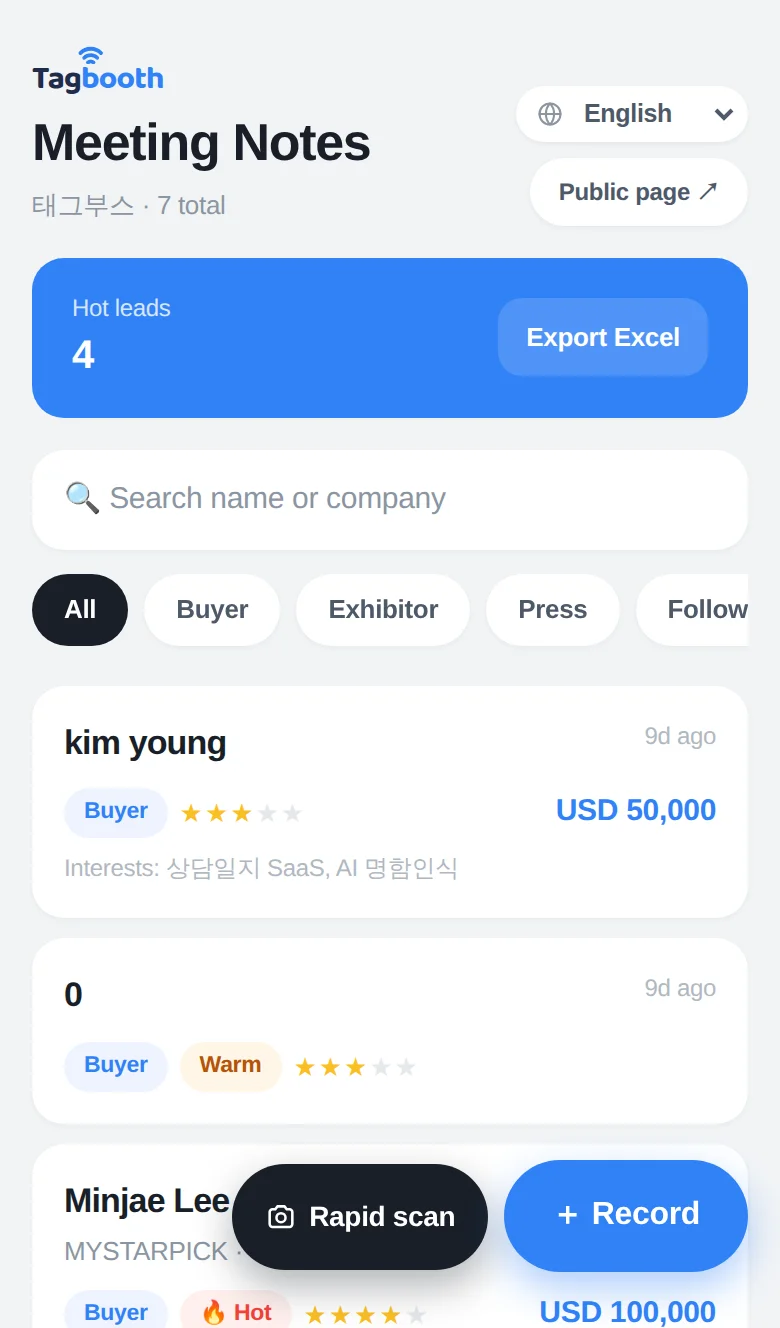
Everything above compresses into one instruction: score the lead immediately after the conversation, based on facts, with a one-line note attached. The hard part is doing that with paper forms or a spreadsheet. TagBooth is built around exactly this constraint — a QR or NFC tag at your booth opens a capture screen where lead temperature (hot/warm/cold) is a one-tap chip, alongside a 0–5 star rating, visitor type (buyer/general/exhibitor/press), predefined chips for products of interest and follow-up actions, and a deal-size field supporting eight currencies. AI business card recognition handles contact entry, so the whole record takes around 30 seconds. After the show, the event report includes a temperature distribution chart — a quick read on event quality: an unusually low hot ratio is a reason to rethink the show, the booth location, or the pre-show outreach — and everything exports to Excel as a ready-made follow-up list. You can try the capture flow with no installation on the demo page, and the full workflow is laid out in how it works.
FAQ
What do I do when a lead sits on the border between hot and warm?
Use timeline as the tiebreaker. If a concrete timeframe (a specific quarter or month) came up in conversation, mark it hot; clear interest with no stated timing is warm. When genuinely unsure, choose warm and record why in the note — a defensible warm is far more useful than an inflated hot that erodes the ranking.
Should we just discard cold leads?
No. Cold means no purchase intent today, not never — and keeping cold leads in a low-cost channel like a newsletter costs almost nothing. A meaningful share of them resurface at the next show or warm up when a new budget cycle opens, and by then you already have the relationship on record.
Why add a star rating if we already have temperature?
Temperature marks the stage of the buying journey; the star rating expresses relative confidence within a stage. If you come home with 20 warm leads, stars give you an ordering inside that group. It is optional, but at high-volume shows it adds a second sort key that temperature alone cannot provide.
How do we keep temperature criteria consistent across the team?
Agree on a written, fact-based definition before the show — for example, "hot means at least two of budget, timeline, and authority were confirmed" — and require a one-line justification note with every rating. A ten-minute end-of-day review of that day's hot leads on day one aligns everyone's bar quickly for the rest of the show.