Your Booth's Results Depend Less on Location, More on Time-of-Day Strategy
Booth location is set by lotteries and budgets — how you run each hour is up to you. Visitor patterns by time of day, staffing plans, and using meeting data to design your next show.
You usually can't control your booth's location — but you fully control how you run each hour of the day. The booths that win meetings and quality leads aren't the ones with the best spots; they're the ones that operate differently at 10 a.m. than at 3 p.m. This guide covers reading the daily rhythm of a trade show and adjusting staffing, messaging and goals by time of day.
Why you should let go of the location obsession
Booth locations are typically set by application order, booth size, and organizer allocation — variables an exhibitor can't change. Yet results vary widely between booths in identical spots, and the difference is time-of-day operations.
A prime spot by the entrance still leaks meetings if it's understaffed at peak; a corner booth still lands dense, high-intent conversations if it catches purposeful buyers during quiet hours. Time spent regretting an uncontrollable variable (location) is better invested designing the controllable one (your hours).
The rhythm of a show day — visitors differ by hour
Every show is different, but a commonly observed daily rhythm looks like this:
| Time | Typical visitors | Your booth's goal |
|---|---|---|
| Right after opening | Purposeful buyers, pre-booked meetings | Dense conversations; put senior people on |
| Around lunch | Foot traffic dips; your staff rotate too | Tidy notes, review the morning's hot leads |
| Afternoon peak (often 2–5 p.m.) | General visitors surge, groups | Short interactions + triage; lead capture running |
| Last hour | Decision-makers circling back to close their day | Catch morning contacts returning; lock next steps |
The point isn't to trust this table — it's to verify your booth's actual rhythm with data. If your meeting notes carry timestamps, your own peak hours become visible from day two of the show.
Change staffing and messaging by the hour
- Morning — field your aces. This is when purposeful buyers come. The people who know product and pricing in depth should be on, and long conversations are fine.
- Peak — triage is the goal. You can't talk to everyone at length. Identify the visitor type in 30 seconds, record temperature and product interest for promising contacts, and move the depth to follow-up. Let a QR code hand out brochures and your company page so staff time goes to conversations.
- Last hour — manufacture commitments. Not "come back tomorrow," but "I'll send the quote tomorrow" — next steps that continue outside the booth. Match shift changes to the rhythm too: finish meals before the peak, everyone on the floor during it, notes and tidy-up in the lulls.
Design your next show from the data
Time-of-day strategy pays off again after the show, if your notes carry timestamps:
- When was our actual peak? (If it differed from expectations — why?)
- Which hours produced the hot leads — the peak's volume, or the morning's few deep conversations?
- How did days differ? If day one's afternoon was strongest, staff the next show accordingly.
All of this has one precondition: meetings recorded immediately, with time attached. If all that's left after the show is a stack of business cards, hour-by-hour analysis is impossible. For the broader measurement framework, see our trade show ROI metrics guide.
Meeting notes that timestamp themselves — TagBooth
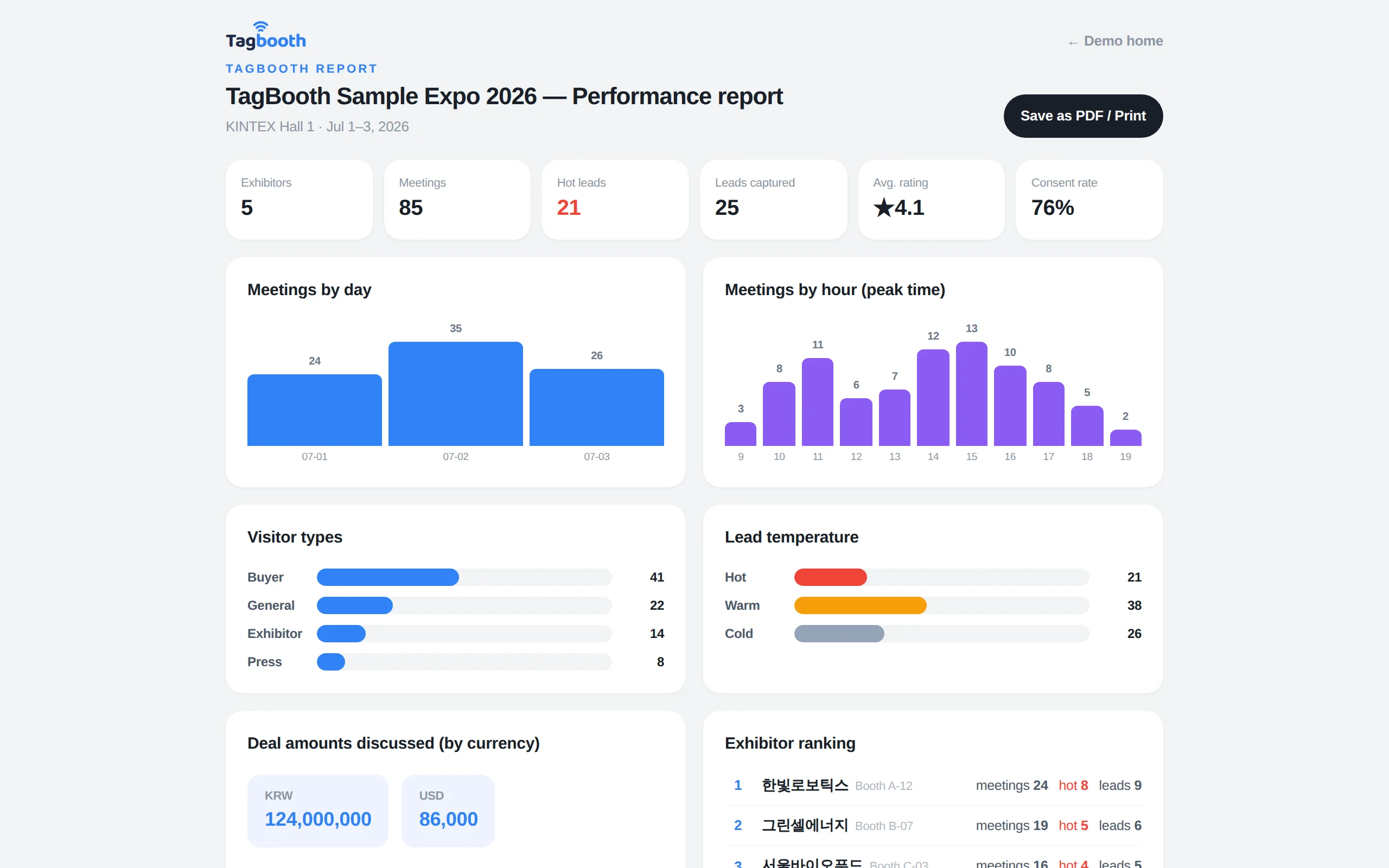
Record meetings with TagBooth and time-of-day analysis stops being extra work. Every 30-second note logged from the booth tag is stamped in the event's timezone automatically, and the event report draws the meetings-by-hour (peak time) chart and daily trend for you.
Organizers see event-wide peak hours and per-exhibitor results on one screen, and export print-ready PDFs and Excel as evidence for planning the next edition. You can see what the report looks like in the demo's sample performance report — no account needed — and the full flow in how it works.
FAQ
Does booth location really not matter?
It matters — it's just not controllable. Entrance and main-aisle spots do see more foot traffic, but foot traffic doesn't automatically become meetings or lead quality. For a location you've already been assigned, hour-by-hour operations are the only lever that changes outcomes.
How do I find my booth's peak hours?
If your notes carry timestamps, you'll see it by the first evening: count meetings per hour and compare against your assumptions. If reality differs, adjust the next day's staffing. A tool that draws the hourly chart automatically turns this check into a one-minute task.
Doesn't meeting quality drop during peak hours?
Only if you define the peak's goal as deep conversations. Define it as accurate triage instead: record type, temperature and product interest in 30 seconds, and push the depth to follow-up. The peak's volume then becomes your post-show pipeline rather than a quality problem.
The last hour is empty — can we tear down early?
Common field experience says the final hour has little foot traffic but brings back decision-makers closing out their day. If a morning contact said they'd "stop by again," this is when. An empty booth cancels that promise — prepare your teardown, but keep one person able to talk.