How Event Organizers Turn Lead Retrieval Into a Revenue Line
At major international trade shows, lead retrieval is a standard organizer-provided service. Here is how it drives exhibitor retention, sponsor reporting, and booth package value.
If you organize trade shows or run events as an operating agency, lead retrieval is not just an exhibitor problem — it is one of the most underused levers you have. At major international trade shows, lead retrieval is a standard value-added service that organizers provide or sell to exhibitors: it raises the value of the booth package, generates the performance data that convinces exhibitors to rebook, and in many cases becomes a revenue line of its own. In markets where paper guest books and business card boxes are still the norm at booths, the organizer who offers this service first gains a differentiation advantage that compounds with every edition of the event.
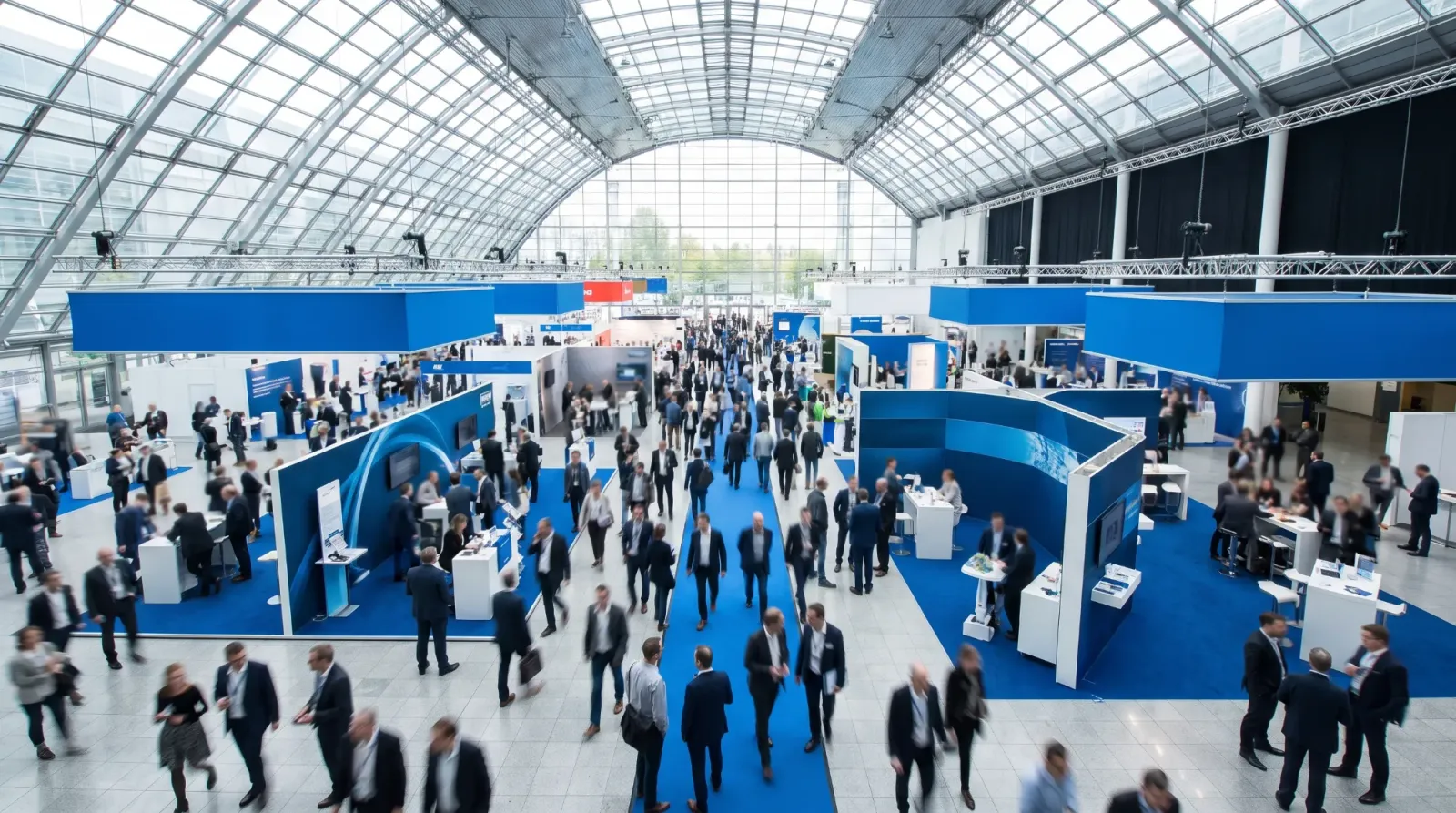
What is lead retrieval, and why did it become the organizer's job?
Lead retrieval means digitally capturing visitor information and conversation details at exhibitor booths — typically by scanning a badge QR code or tapping a tag at the stand — instead of collecting business cards and hoping someone types them up later.
The important part is who provides it. At large international shows — the market served by event tech companies like Cvent and ExpoPlatform — exhibitors do not each bring their own tooling. The organizer designates an official lead retrieval service and either bundles it into the exhibitor package or sells it as a paid add-on. Exhibitors get a proven tool delivered with their registration; the organizer gets something more valuable: every conversation across the show floor flows into one consistent, event-level dataset.
The logic behind this model is straightforward. An exhibitor's decision to return next year comes down to one question — did the show produce results? The party best positioned to create the data that answers that question is not the exhibitor. It is the organizer.
What does the organizer actually gain? Four concrete benefits
1. Hard evidence for rebooking conversations
The toughest moment in exhibitor sales is hearing "we tried it last year and couldn't tell if it worked." When lead retrieval is provided at the event level, every exhibitor leaves with a concrete record: number of conversations, lead temperature distribution, products of interest. An organizer who can open next year's rebooking call with "your team logged this many qualified conversations at our last show" negotiates from a very different position than one relying on attendance figures and goodwill.
2. A unified performance report for the whole event
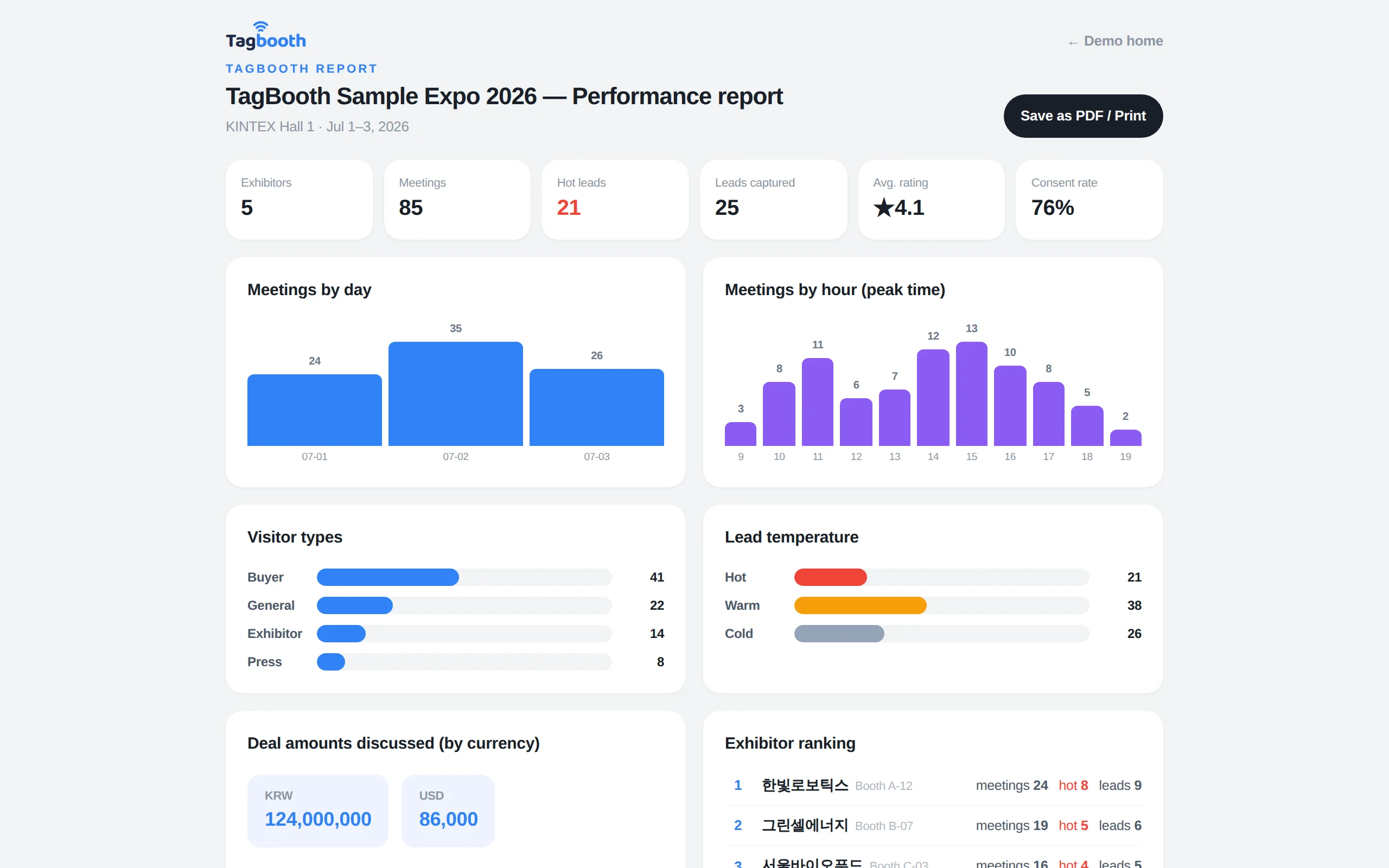
After the show closes, organizers answer to government agencies, industry associations, and sponsors. Headline attendance numbers are no longer enough. When conversations from every exhibitor are aggregated at the event level — daily and hourly activity trends, lead temperature distribution, exhibitor performance rankings — the organizer can present the show's real commercial output in quantitative terms. That report becomes the backbone of next edition's budget case and sponsorship pitch.
3. A booth package that stands apart
Floor space, power, and basic furniture look the same from every organizer. Add "official lead capture service included" and the package changes character: something exhibitors previously had to arrange themselves becomes a benefit of participating. It also slots naturally into premium booth tiers and sponsorship bundles. In international markets, lead retrieval frequently operates as an independent ancillary revenue line for the organizer, not just a cost of doing business.
4. Less exhibitor support workload during the show
A large share of the questions an organizer's office fields during an event concerns booth operations. When every stand improvises with paper guest books and card boxes, the same questions repeat: how do we compile our visitor list, how do we get our data after the show. Providing one standardized digital tool from the start replaces dozens of improvised workflows with a single consistent one — and the support burden shrinks accordingly.

Why is this an open opportunity in emerging exhibition markets?
Walk the floor at a typical domestic trade fair in markets where this model has not yet arrived, and you will still see paper sign-in sheets on booth counters and business cards piling up in bowls. Post-show performance analysis is left entirely to each exhibitor, and the organizer's deliverable ends at floor space and utilities.
That gap is the opportunity. By offering lead capture as an official service, an organizer gains two things at once. First, a clear differentiator in exhibitor acquisition: "our show manages your meeting outcomes, not just your floor space." Second, a head start on accumulating event-level performance data. Data is an asset that appreciates with every edition — the organizer who starts collecting first builds an advantage that competitors cannot copy retroactively.
What should you check before rolling it out? A selection checklist
When evaluating a lead retrieval service, organizers need to weigh two things simultaneously: the exhibitor's on-site experience and the organizer's own reporting requirements. Use the checklist below.
| What to verify | Why it matters | Questions to ask |
|---|---|---|
| Exhibitor onboarding burden | Tools requiring app installs, account setup, or training see poor adoption on a busy show floor | Does it work without an app install? Can temporary booth staff use it with zero training? |
| Multilingual support on site | International shows mix overseas buyers, interpreters, and local staff | Do both the staff and visitor screens support multiple languages? |
| Data ownership and privacy | Any mixing of conversation data between exhibitors becomes a trust problem immediately | Is data fully isolated between companies? Is the privacy model clearly documented? |
| Event-level consolidated reporting | Reporting to agencies and sponsors is the core reason organizers adopt this | Are all exhibitors' conversations automatically aggregated into one event report? |
| Exhibitor account provisioning | Your office must handle dozens or hundreds of exhibitor accounts | Are accounts issued automatically when the organizer registers a company? |
| Record integrity | If performance data can be questioned as tampered, it loses its value as evidence | Is there a mechanism to prove records have not been altered? |
Onboarding burden is the most commonly underestimated item on this list. Booth staff often join on the morning of the show. A tool that needs installation and training — however capable — risks sitting unused precisely when it matters.
How TagBooth was built for exactly this model
TagBooth is a QR and NFC tag-based meeting capture service for trade shows, designed from the ground up around a three-tier structure: organizer, event, exhibitor — a direct implementation of the organizer-provided model described above.
When an operating company creates an event and registers its exhibitors, each exhibitor's account is issued automatically. At the booth, a single tag opens two things: a 30-second meeting capture screen for staff, and a company profile and brochure page for visitors — with no app install on either side. One-touch chip input and business card recognition that handles mixed Korean and English text keep on-site training close to zero, while a 10-language interface and 8 supported currencies cover international shows.
For the organizer, the crucial part comes next. Every conversation across all exhibitors is automatically tagged to the event, producing a consolidated performance report — daily and hourly charts, lead temperature distribution, company rankings — exportable to PDF and Excel. Data remains fully isolated between exhibiting companies, and audit logs are sealed daily in a hash chain and anchored to Bitcoin via OpenTimestamps, giving the performance data verifiable integrity. You can try the actual screens in the live demo with nothing to install, and the rollout flow is laid out in how it works.
FAQ
Does providing lead retrieval give the organizer access to exhibitors' data?
It should not, and in the standard model it does not. Detailed conversation records belong to each exhibitor alone, while the organizer sees aggregated event-level metrics. TagBooth enforces complete data isolation between companies and surfaces only the consolidated event report to the organizer, so exhibitors' sales information is never exposed.
Can our event office realistically manage accounts and training for dozens of exhibitors?
Yes, if account provisioning is automated. With TagBooth, the organizer registers exhibitors to the event and accounts are issued automatically; login uses email verification codes, so there are no passwords to reset. On-site usage amounts to tapping a tag, which means booth staff can start without a training session.
Can the event report be used for submissions to agencies and sponsors?
That is one of the primary reasons organizers adopt the model. The consolidated report includes daily and hourly conversation trends, lead temperature distribution, and exhibitor performance rankings, and exports to PDF and Excel for direct submission. It shifts post-event reporting from attendance counts to documented commercial activity.
Is this worth it for smaller fairs and regional events?
If exhibitor retention matters to your event, yes — regardless of scale. Smaller events feel the loss of each exhibitor more acutely, which makes a data-backed rebooking case proportionally more valuable. And in markets where paper guest books are still the norm, a smaller event offering official lead capture stands out even more sharply against its competition.