Trade Show Lead Capture Apps Compared (2026 Buyer's Guide)
Badge scanners, business card apps, and dedicated lead capture SaaS — how the main options stack up in 2026, plus the five criteria that actually decide which one fits your booth.
The fastest way to choose a trade show lead capture tool is not to line up feature grids — it's to understand which category of tool you're actually shopping for. In 2026, lead capture options fall into three distinct types — organizer-run badge scanning (lead retrieval), general-purpose business card scanner apps, and dedicated trade show lead capture SaaS — and the right type depends on how many shows you exhibit at, whether you exhibit internationally, and how your follow-up process works. This guide compares the three types, summarizes what published comparisons say about Captello, momencio, iCapture, and Cvent LeadCapture, and gives you a five-point checklist for making the call.
Why should you pick a category before picking an app?
Lead capture methods look similar from the booth, but they differ fundamentally in where the data lives and who pays for the tool. Badge scanning is an add-on service sold by the event organizer. Card scanners are personal productivity apps. Dedicated SaaS is a business system that an exhibitor — or an organizer — deploys deliberately. If you start comparing individual apps before settling on a category, you'll burn hours evaluating tools that were never viable for your event in the first place.
Type 1 — Organizer badge scanning (lead retrieval)
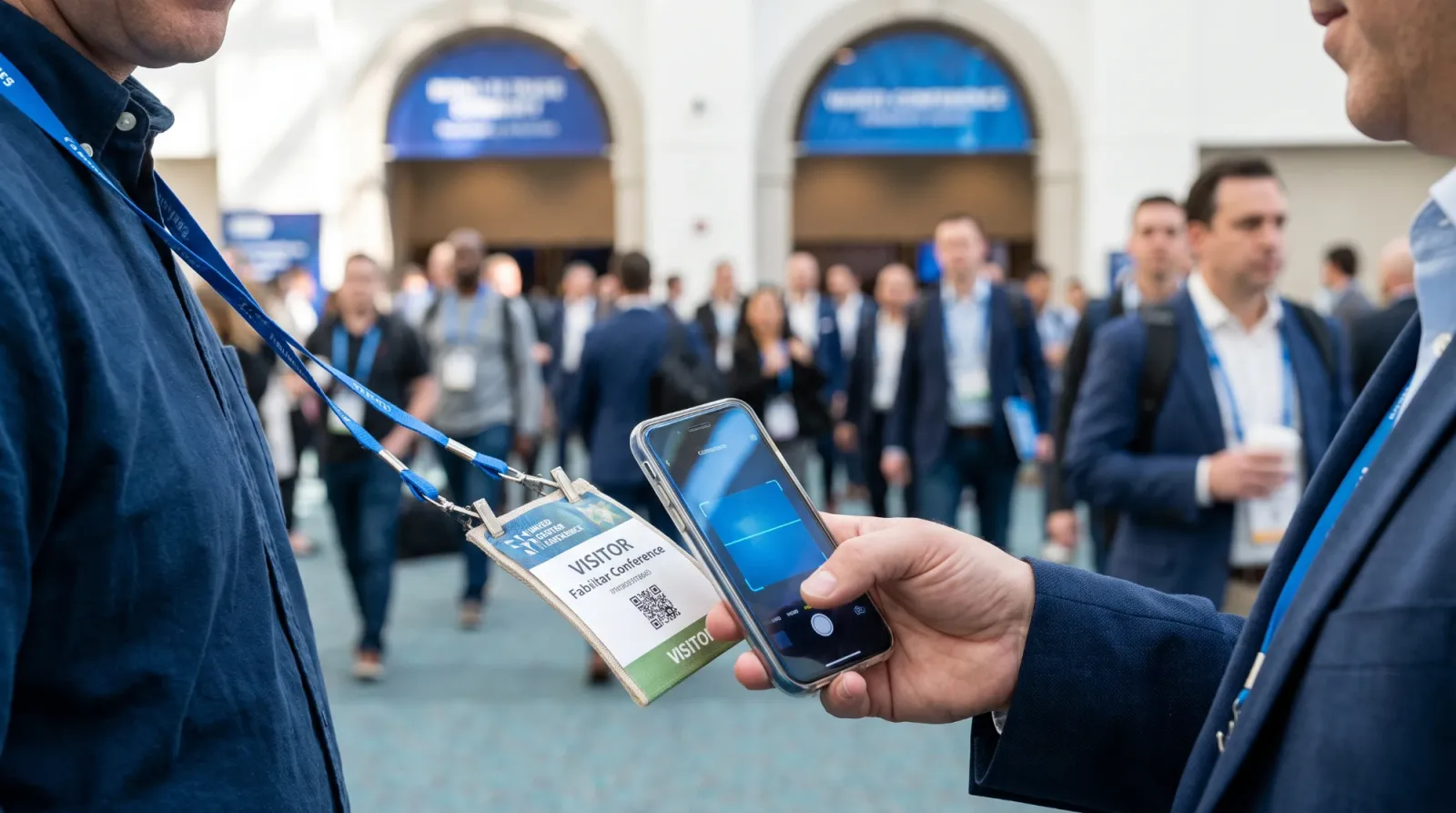
With lead retrieval, you scan the QR or barcode on attendee badges issued by the organizer and receive the registration data behind them. The upside is accuracy: name, company, and email come straight from what the attendee entered at registration, so transcription errors are rare. The downsides are just as clear. It only works at that one event, you buy it again for every show, and it captures nothing beyond the badge — not what you discussed, not how serious the prospect is. And if the organizer doesn't offer lead retrieval at all, this option simply doesn't exist for you.
Type 2 — General-purpose business card scanner apps
Card scanner apps turn a photo of a business card into a contact record. They work at any event, and the cost per user is negligible. On a busy show floor, though, the limits show quickly. There is no structure for capturing conversation context — products of interest, budget signals, lead temperature. Consolidating leads from multiple team members into a single event view is clumsy at best, and event-level performance reporting is out of scope entirely. Card scanners solve contact collection; they do not solve lead management.
Type 3 — Dedicated trade show lead capture SaaS
Dedicated platforms combine badge scanning and card recognition with conversation capture, lead qualification, CRM sync, and event reporting. For companies exhibiting at several shows a year, they are the most complete option. The trade-offs: they carry the highest price tag of the three types, they require pre-show setup and staff training, and nearly all of them are sold to individual exhibitors — which can be hard to justify if you're taking a single booth to a single show.
How do the major lead capture tools compare in 2026?
The summary below is based on comparison articles published in 2026 by vendors and reviewers in this space — Wave Connect, BoothIQ, and Blinq among them. All pricing figures are as stated in those published comparisons; actual quotes vary with team size and contract terms.
| Tool | Standout strength | Pricing per published comparisons | Best fit |
|---|---|---|---|
| Captello | Gamification — booth games and prize draws that pull traffic | From about $500 per event | Teams running engagement activations alongside capture |
| momencio | AI-driven lead analysis and follow-up automation | Roughly $3,000–5,000 per year | Teams that want capture and follow-up in one tool |
| iCapture | CRM integration and data quality controls | Around $8,000 per year | Enterprises with an established Salesforce-style pipeline |
| Cvent LeadCapture | Native fit with the Cvent ecosystem | $200–500 per event | Organizations already registering events through Cvent |
A little more color on each. Captello leads with booth gamification — spin-to-win wheels, quizzes, leaderboards — which makes it a natural pick when traffic generation and lead capture need to happen in the same footprint. momencio leans into what happens after the scan, using AI to score leads and drive personalized follow-up content. iCapture is the data-quality specialist: required fields, dedupe, qualification questions, and tight CRM mapping, priced accordingly at the top of the range in the published comparisons. Cvent LeadCapture is less a standalone purchase and more the default option at events already running on Cvent registration and badging.
One thing all four share: they are fundamentally exhibitor-purchased tools. Whether billed per event or per year, each exhibiting company signs its own contract and manages its own setup.

What five criteria actually decide the choice?
Long feature lists blur judgment. In practice, five criteria determine whether a tool survives contact with a real booth.
| Criterion | The question to ask | What happens if you miss it |
|---|---|---|
| Capture speed | How many seconds per lead? Does it hold up at peak traffic? | Peak-hour conversations evaporate unrecorded |
| Card and badge recognition | Does card scanning auto-fill fields? Can it handle mixed-language cards? | Manual data entry after the show, typos and gaps |
| Multilingual booth staff | Can interpreters and local staff use the UI in their own language? | Training overhead grows; staff quietly stop logging |
| Reporting | Can you pull event-level results — counts, lead temperature, hourly patterns — immediately? | Spreadsheet archaeology; no evidence for the re-book decision |
| Organizer integration | Does it connect to this event's badge system? If not, what's the fallback? | Registration data unavailable, everything entered twice |
The second and third criteria trip up international exhibitors more than any others. Many tools struggle with business cards that mix scripts — Korean and English on the same card, for instance — and if the interpreters or local temp staff you hire on-site can't work in their own language, all the logging quietly funnels back to one overloaded manager.
Where does the exhibitor-purchase model fall short?
Every tool above rests on the same assumption: each exhibiting company selects and pays for its own software. That assumption holds up well for mid-size and enterprise exhibitors with annual event budgets. It breaks down at events assembled by trade associations, regional agencies, and show organizers — events where dozens or hundreds of small exhibitors share a hall. Most of those exhibitors will never sign an individual SaaS contract, so the event's collective conversation data ends up living in card stacks and memory. The organizer feels this too: with no common capture layer, there is no way to report how many meetings the event actually generated or what they were worth.
Where TagBooth fits in this comparison
TagBooth takes a structurally different route aimed at exactly that gap. Instead of each exhibitor buying its own tool, the event organizer or operator deploys TagBooth per event and provides it to every exhibiting company. The operator creates the event and registers the exhibitors; each booth gets a single QR/NFC tag. When a staff member opens the tag, they land on a 30-second lead capture screen; when a visitor opens the same tag, they see the company's profile and brochures. No app install on either side.
Mapped against the five criteria: capture runs on pre-defined one-touch chips, so the only typing is the deal amount; AI card recognition handles mixed Korean-English cards; the UI ships in ten languages, including right-to-left Arabic, so local staff work in their own language; and when the event closes, the performance report — daily and hourly charts, lead temperature distribution, company rankings — exports to print, PDF, or Excel. Data is fully isolated between exhibiting companies, and access audit logs are sealed daily into a hash chain anchored to Bitcoin via OpenTimestamps.
To be fair about fit: TagBooth is not the answer to every scenario. If your company exhibits at dozens of shows a year on its own budget and needs deep, bespoke CRM pipeline integration, the exhibitor-purchased tools above may serve you better. If you organize or operate events — or you want a shared capture layer that lifts every exhibitor at your show to the same standard of record-keeping — the organizer-deployed model is the structural advantage. You can try both the staff and visitor views in the live demo with nothing to install, and the full operator-to-event-to-exhibitor flow is laid out in how it works.
FAQ
Isn't the organizer's badge scanner enough on its own?
Badge scanning is the most accurate way to pull registration data, but it captures nothing about the conversation — products discussed, buying intent, lead temperature. Personalizing follow-up requires a layer of conversation capture on top of the badge data. Badge scanning is also event-specific, so you purchase it again at every show.
What does trade show lead capture software typically cost?
Per comparison articles published in 2026 (Wave Connect, BoothIQ, Blinq, and others), per-event pricing runs $200–500 for Cvent LeadCapture and from about $500 for Captello, while annual subscriptions run roughly $3,000–5,000 for momencio and around $8,000 for iCapture. Actual quotes depend on seats, event volume, and contract terms, so always confirm directly with the vendor.
Can we just start with a free business card scanner app?
If one or two people staff your booth and lead volume is low, a card scanner covers basic contact collection. But without conversation capture, team-level consolidation, or event reporting, it stops scaling the moment volume grows. If you exhibit more than twice a year or run a multi-person booth, a purpose-built tool usually pays for itself in recovered follow-up.
We're an exhibitor and the organizer provides no tool — what are our options?
You can either contract an exhibitor-purchased SaaS directly or propose that the organizer adopt a shared tool for the whole event. An organizer-deployed model like TagBooth puts every exhibitor on the same capture standard and gives the organizer event-wide performance data in return, which makes it a proposal organizers have their own reasons to consider.