Trade Show Follow-Up Emails That Actually Get Replies — With 3 Copy-Paste Templates
Six principles for trade show follow-up emails that get replies, a lead-temperature strategy table, and three copy-paste templates for hot, warm, and brief-contact leads.
The formula for a trade show follow-up email that gets a reply is simpler than most exhibitors expect: send it within 48 hours, open with the specific conversation you had at the booth, and attach whatever you promised during that conversation. Emails that get ignored share the opposite traits — they arrive a week late, read identically for every recipient, and open with "Thank you for visiting our booth." This guide covers the principles that drive reply rates, how the strategy changes by lead temperature, and three templates you can copy, fill in, and send.

Why do most trade show follow-up emails get ignored?
Industry surveys consistently point to the same problem: 70 to 80 percent of trade show leads never receive any follow-up at all. But even the leads that do get an email often go quiet, and the reason becomes obvious once you look at it from the buyer's side.
In the week after a show, a purchasing manager's inbox fills up with dozens of near-identical messages. Almost all of them start with a generic thank-you and pivot straight into a company pitch that could have been sent to anyone. The recipient opens the email, sees nothing that reflects the actual conversation they had, and closes it. There is simply no reason to reply.
The competitive edge in follow-up, then, is not copywriting. It is whether you can reference what the two of you actually discussed — the product they asked about, the question they raised, the document you promised. And that is decided not when you write the email, but at the booth, in the moment the conversation happened.
What makes a follow-up email get a reply? Six principles
1. Send within 48 hours
Follow-up performance is a function of speed. Every day that passes, your booth fades from the prospect's memory and a competitor's email lands first. Hot leads should hear from you the same evening or the next morning — 48 hours is the outer limit. "I'll send it once I've sorted through everything" is how leads go cold.
2. Open with the booth conversation, not a generic thank-you
Not "Thank you for stopping by our booth," but "Here's the EU certification documentation for the B2 model you asked about." The entire job of the first sentence is to make the reader think, "Right — that company." That doesn't require elegant prose; it requires a record of the conversation: the product they cared about, the questions they asked, what you agreed to do next.
3. Attach exactly what you promised
If you said "I'll send you a quote" or "I'll share the spec sheet," the follow-up email is where you keep that promise. An email that delivers on a commitment reads as business correspondence, not a sales blast, and gets treated accordingly. An email that forgets the promise does the opposite — it costs you trust.
4. Put the event name and something specific in the subject line
The subject line decides whether your email gets opened at all. "Hello from Acme Corp" gets skipped. Event name plus a concrete deliverable gives the recipient instant context: "Your B2 model quote from K-Expo 2026" tells them exactly why this email matters before they open it.
5. Never send a mass blast
A single message sprayed to a hundred recipients is efficient only for the sender. Readers detect a mass email within two lines and close it. If you have too many leads to write each one from scratch, the practical middle ground is the approach below: segment by lead temperature, then swap only the personalized fields in a template.
6. Run a different sequence for hot, warm, and cold leads
Treating every lead the same means you are too slow for hot leads and too pushy for cold ones. A prospect who discussed budget and timeline needs a quote and a meeting proposal. A prospect who showed interest but had no timeline needs useful material and a low-pressure next step. A prospect who was just gathering information belongs in long-term nurturing.
How should follow-up differ by lead temperature?
The temperature you assigned at the booth determines the timing, content, and goal of every follow-up touch.
| Segment | First email | Core content | Goal | What comes next |
|---|---|---|---|---|
| Hot | Within 24-48 hours | Quote attached + proposed meeting times | Book the meeting | No reply in 2-3 days: short reminder plus a call |
| Warm | Within 48 hours to 1 week | Promised materials + a light next step | Keep the dialogue open | Share relevant content every 1-2 weeks |
| Cold | Within 1 week | Brief thanks + something genuinely useful | Stay memorable | Long-term nurturing via newsletter or updates |
One thing this table quietly assumes: by the time the show ends, your leads are already sorted into hot, warm, and cold. If all you brought home is a stack of business cards, temperature-based sequencing never gets off the ground.
Three copy-paste follow-up email templates
Replace the bracketed fields with details from your booth notes. These follow standard English business email conventions — first-name greeting, short paragraphs, one clear ask.
Template 1 — Hot lead (quote attached)
For prospects who discussed specifics like volume, budget, or timeline, deliver the quote and propose the meeting in the same email.
Subject: [Event name] — your [product name] quote, as promised
Hi [First name],
Great speaking with you at [event name] on [day]. Thanks for taking the time to walk me through [their situation — e.g., your plans to expand the packaging line next quarter].
As promised, I've attached the quote for [product name], based on [conditions discussed — e.g., the annual volume and delivery terms we talked through at the booth].
The details are usually easier to work out live. Would [option 1 — e.g., Tuesday at 10:00] or [option 2 — e.g., Thursday at 15:00] work for a 30-minute call? If neither fits, just let me know a time that suits you.
Happy to send anything else you need for the evaluation.
Best regards, [Name] [Title], [Company] | [Phone]
Template 2 — Warm lead (sending materials)
For prospects who were interested but had no clear timeline, keep the promise and offer a next step they can accept without committing to anything.
Subject: The [product/topic] materials you asked about at [event name]
Hi [First name],
Good to meet you at [event name] — I enjoyed our conversation about [discussion topic — e.g., automating your inbound QA process].
Here's the [material — e.g., product catalog and case study deck] I mentioned at the booth. [One pointer tied to their situation — e.g., Page 3 covers a deployment at a company in your industry, which I think maps closely to what you described.]
Have a look whenever it's convenient, and reply with any questions. If it would help, I'm glad to set up a 20-minute walkthrough — no pressure either way.
Best regards, [Name] [Title], [Company] | [Phone]
Template 3 — No-show or brief-contact lead
For people you only exchanged cards with, spoke to for a minute in a crowded aisle, or who missed a planned meeting, the goal is simply to reopen the door.
Subject: Following up from [event name]
Hi [First name],
We met briefly at [event name] — the booth was packed that day, so we never got the chance to talk properly.
In one line: [what your company does, for whom — e.g., we help mid-size electronics manufacturers cut inbound inspection time]. Given [their company]'s work in [their likely area of interest], I thought a short overview might be relevant, so I've attached one.
No response needed — but if this lands anywhere near a project you're planning, I'd be glad to talk. Either way, thanks for stopping by.
Best regards, [Name] [Title], [Company] | [Phone]
Good follow-up starts at the booth, not at your desk
Look back at those three templates: almost every bracket is filled not by writing skill but by a record — which product they asked about, what you promised to send, whether the lead was hot or warm. Without that record, even the best template collapses back into a mass email.
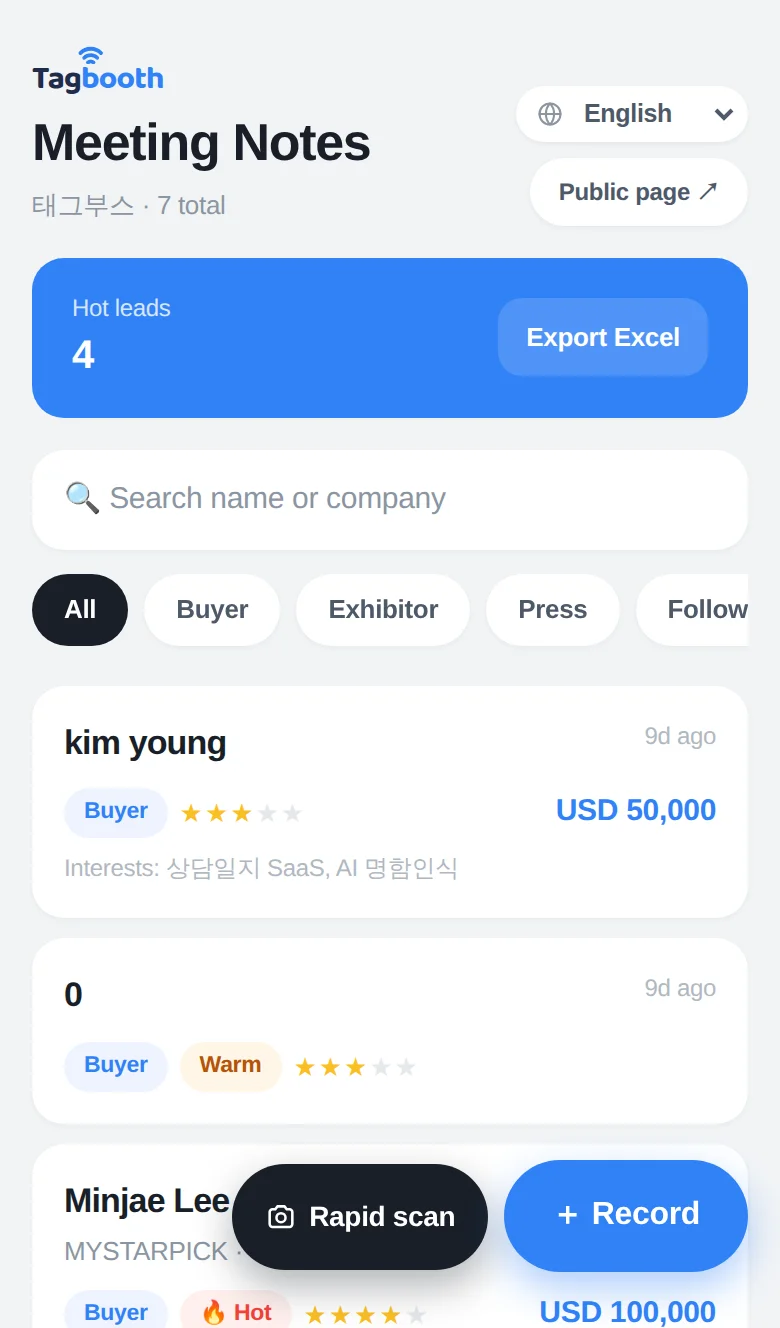
The catch is that a busy booth is a terrible place to take notes. That is the exact problem TagBooth is built for. Staff scan the booth's QR or NFC tag and log a conversation in about 30 seconds by tapping pre-set chips — products of interest, lead temperature (hot/warm/cold), the follow-up you promised, even the deal size in any of eight currencies. Business cards are captured with a single photo, with AI recognition that handles mixed Korean and English cards. After the show, you export everything to Excel, sort by temperature, and drop the recorded details straight into the templates above — your follow-up is essentially pre-written. You can try it without installing anything on the demo page, and the full workflow is laid out in How it works.
FAQ
When is the best time to send a trade show follow-up email?
Within 48 hours of the show closing, and for hot leads, the same evening or the next morning. Memory of your booth decays fast and competitors' emails arrive quickly, so a good email sent early consistently outperforms a perfect email sent late. If the show runs several days, follow up with hot leads while the show is still on rather than waiting for the end.
Is personalization realistic when I have hundreds of leads?
Yes, as long as you don't try to write every email from a blank page. Segment leads into hot, warm, and cold, pick the matching template, and swap only the bracketed fields using your booth records. If products of interest and promised follow-ups were captured as structured selections at the booth, that swap takes one to two minutes per lead.
What should I do if there's no reply to the first follow-up?
For hot leads, send a short reminder after two to three business days and back it up with a phone call. For warm leads, make two or three more touches at one-to-two-week intervals, each time including something useful rather than just "checking in." If there is still no response, reclassify the lead as cold and move it into long-term nurturing until the next show or product launch creates a fresh reason to reconnect.
What makes a good subject line for a trade show follow-up email?
Combine the event name with a concrete deliverable: "Your B2 model quote from K-Expo 2026" or "The case studies you asked about at Hannover Messe." That combination gives the recipient instant context and a reason to open. Avoid company-name-only greetings and promotional phrasing, both of which read as mass email and get skipped.