FIX 2026 Daegu Field Report - Keeping Leads Straight Across a Four-Day Mega Expo
We exhibited at FIX 2026, the Future Innovation tech eXpo with 588 companies, and ran a four-day booth. Here is how we kept leads separated by day, handled overseas buyers, and survived day four, in a form other exhibitors can reuse.
At a four-day expo, the first thing to collapse is your memory of day-one leads. From October 21 to 24, 2026, Melaka, the company behind TagBooth, exhibited at FIX 2026, the Future Innovation tech eXpo at EXCO in Daegu. With 588 companies across roughly 2,000 booths it was the largest edition yet, and by the evening of day two the faces from day one were already blurring. This report covers how we kept leads from mixing across days at a large multi-show expo.

What FIX 2026 was
FIX stands for Future Innovation tech eXpo, and this was its third edition under the slogan "AI, Beyond Tech into Reality". It bundles several shows into one venue: the Daegu International Future Auto and Mobility Expo (DIFA), the 15th Daegu International Robot Industry Expo, the ICT Convergence Expo Korea, PNP Korea Expo, and the Startup Arena.
According to closing-day coverage, 588 companies filled about 2,000 booths and roughly 117,000 visitors came through, with 162 overseas companies making up more than 27 percent of exhibitors. Beyond the exhibition, four days carried a conference with 61 speakers from 14 countries, an export consultation program with 88 buyers from 19 countries run with KOTRA, a procurement meeting program with 50 large corporations, a job fair, and the Innovation Awards.
For an exhibitor, one number matters most: four days. That is not simply twice a two-day show. It is long enough for new problems to appear, mixed-up leads and worn-out staff among them.
Three points where lead management breaks at a large expo
First, days blur together. Look at the pile of business cards on the evening of day three and you cannot tell who came on Tuesday and who came today. Whether your follow-up email can say "we met at the booth last Tuesday" decides whether it gets a reply.
Second, languages and currencies mix. With a high share of overseas exhibitors and an export consultation program in the same week, English, Japanese, and Chinese-speaking visitors arrive together. Write a deal size down and you will not remember later whether it was dollars, won, or yen.
Third, nobody records on day four. The last day is when energy is lowest and conversations loosest, and it is also the day decision-makers come back to wrap things up. The most important return visits land on the day least likely to be recorded.
What was on the booth
| Item | Role | Note |
|---|---|---|
| Card stand (A6) | Visitor-scanned QR for company intro, brochures, contact form | Reused the event's navy key visual with its four-color diagonals |
| Lanyard card | Staff-scanned QR for the 30-second record | One per staff member |
| NFC cards | Inside the stand and lanyard holder | Tap on Android, QR on iPhone |
| One instruction sheet | Explains stand versus lanyard | No briefing needed when shifts change |
A four-day show means shift changes. A replacement had to be able to log in and record with nothing more than the instruction sheet and a lanyard, so we registered a staff account for every person and each logged in with their own email.
How we kept leads separated by day
Every record automatically carries a timestamp in the event's time zone. We never had to write a date, and each evening we could pull up only that day's records.
We blocked 30 minutes after closing every day. We reviewed that day's records by lead temperature, filled follow-up chips on the hot ones, and tapped a "returning" chip on anyone who said they would come back tomorrow. The next morning we looked only at records with the returning chip and watched for those people.
Those 30 minutes made the biggest difference across four days. By the evening of day four the leads were already sorted into four batches, and the follow-up emails sent the day after closing could say things like "we spoke at the booth on Wednesday afternoon".
How we handled overseas buyers
The export consultation program overlapped with the show, so overseas visitors came steadily. The visitor page opened from the stand QR translates the company intro into the visitor's language automatically, so English, Japanese, and Chinese-speaking visitors read the intro and downloaded brochures in their own language. While staff explained in English, the visitor read along in their language, which took pressure off the conversation.
Deal sizes were entered with a currency selected from dollars, yen, yuan, or won, so the report shows totals per currency without any conversion afterward. Overseas visitors' cards were in English, and the card recognition handled them as usual.
Getting through day four
On the last day we lowered the bar for a record on purpose. The rule was card photo plus temperature chip only, with everything else to be filled in after the show. A lower bar is one you can hold when tired, and holding it means the decision-makers who come back on the last day actually end up in the records.
The other rule was separating "first visit today" from "came back". Records with the returning chip were the warmest batch of all four days, and post-show follow-up started with that batch.
Checklist for a large multi-day expo
| When | Task |
|---|---|
| D-7 | Register every staff member including shift replacements, prepare print and NFC, one instruction sheet |
| D-1 | Upload brochures to the visitor page, confirm currency settings |
| Each morning | Review the previous day's returning-chip list |
| 30 minutes after each closing | Review the day's records by temperature, fill follow-up and returning chips |
| Last day | Lower the record bar to card photo plus temperature |
| Day after closing | Follow up starting with the returning batch, using day-specific wording |
How TagBooth fits in
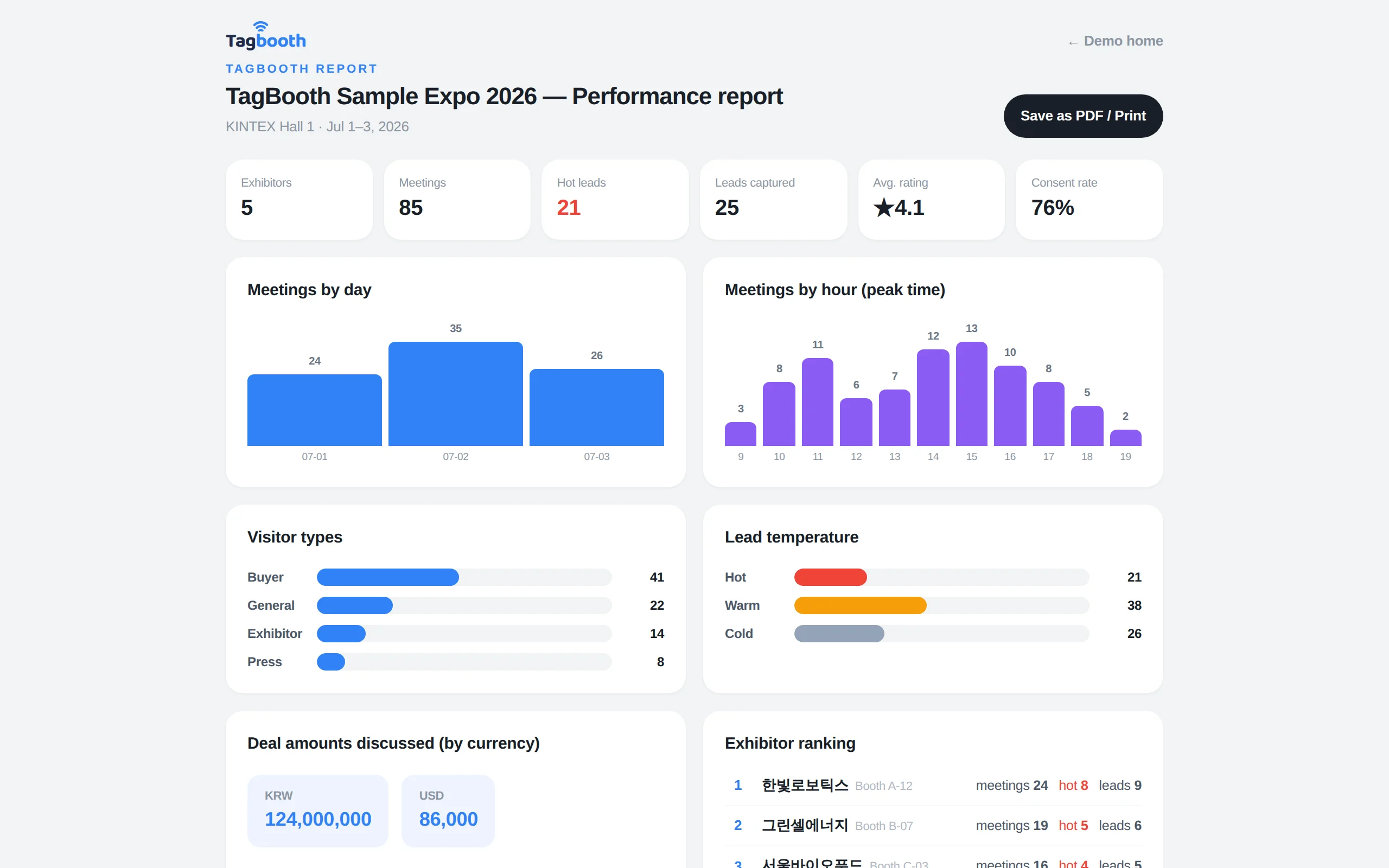
The tool we used at FIX 2026 is TagBooth. Every record carries an event-time-zone timestamp, so days stay separate and the report's daily and hourly charts show the four-day rhythm as it happened. Deal sizes are entered in one of eight currencies with per-currency totals, and the visitor page combines a ten-language UI with automatic intro translation so overseas visitors read in their own language. A company can have several staff accounts, so shift replacements log in as themselves. The report screens are in the demo, and the full flow is described in how it works.
FAQ
What is the easiest way to keep leads from mixing at a four-day expo?
Use a tool that timestamps every record automatically, and block 30 minutes after each day's closing for that day's lead review. Those two habits are enough to write day-specific follow-up emails after the show.
What should we prepare for a high share of overseas visitors?
Two things: a visitor page that opens in the visitor's language, and deal-size entry with a currency selector. One page that adapts to the language is far less work than printing brochures per language.
Do shift changes break the record?
Not if every person has their own staff account. Each logs in with their own email and records to the same booth, so a handover is the instruction sheet and the lanyard card, nothing more.
Do we have to record the same way on the last day?
Lowering the bar is more realistic. Keep the card photo and the lead temperature, and fill in the rest during the post-show review. The goal is not to lose the decision-makers who come back on the final day.