Trade Show Lead Follow-up Is Won in the First 24 Hours
An hour-by-hour follow-up timeline for the day after a trade show — how to triage hot leads, who to contact first, and what to prepare at the booth so speed is even possible.
The battle for trade show leads is decided in the first 24 hours after the show closes. Reach your hot leads while the conversation is still fresh — and before your competitors do — and the meeting becomes a deal. This guide walks through what to do hour by hour, from booth teardown to the next evening, and what to prepare on site to make that speed possible.
Why 24 hours, specifically
Trade show meetings are perishable data, for three reasons.
- Memory fades fast. Your visitor walked dozens of booths in a day. Within a few days, your company blurs into the booth next door. The company that reaches out first becomes "oh right, that booth."
- Your competitors hold the same business cards. If you exhibited, your competitor probably did too — and likely met the same buyers. Follow-up is a game of relative speed, not absolute speed.
- Internal momentum dies. A week after the show, the backlog takes over and the card stack goes into a drawer. Industry surveys have long pointed out that a large share of trade show leads never get followed up at all.
So the plan isn't "email everyone eventually." It's "who gets contacted first, within 24 hours."
The timeline — from teardown to the next evening
| When | What to do | Goal |
|---|---|---|
| Right after close (at the booth) | 5-minute team review of today's hot leads | Fill gaps in notes, confirm temperature |
| Same evening | Finalize hot/warm/cold, assign an owner per hot lead | Ready to dial the next morning |
| Next morning | Personal outreach to hot leads (call or email) | Reference the conversation, propose a concrete next step |
| Next afternoon | Warm leads get an email with the materials they asked about | Relevant attachment, low-pressure reply prompt |
| Next evening | Move cold leads to a long-term track (newsletter etc.) | List closed out, first follow-up cycle done |
The order is the point. Don't send any mass email until every hot lead has received a personal touch. Your highest-probability contacts deserve a message that references the actual conversation — not a copy-paste blast. If you're unsure what to write, the templates in our follow-up email guide are a starting point.
Fast follow-up is decided at the booth, not at the desk
If the morning after the show starts with a stack of cards and "who was this again?", you've already lost the day. The real bottleneck of fast follow-up isn't writing emails — it's the quality of your on-site notes.
Thirty seconds right after each meeting is enough, if you capture four things:
- Lead temperature — one tap: hot, warm or cold. If your team's criteria are fuzzy, align on the lead temperature guide beforehand.
- Products of interest — this decides tomorrow's attachment automatically.
- Follow-up action — a concrete promise: "send quote," "ship sample."
- One line of context — "opening a new plant in October" is what turns a template into a personal message.
With those four recorded, the next morning's job is simply: open the hot list, start at the top, dial.
A team checklist
If you're exhibiting as a team rather than solo, split the roles.
- Before the show: agree on temperature criteria and follow-up options
- During the show: log right after each meeting — interpreters and temp staff use the same standard
- Right after close: 5-minute hot-lead review at the booth to share context the notes can't hold
- Same evening: assign one owner per hot lead (nobody should get three calls from three reps)
- Next day: hot in the morning → warm in the afternoon → cold moved to long-term
- One week later: second touch for unanswered hot leads, then a results review
From note to follow-up in one flow — TagBooth
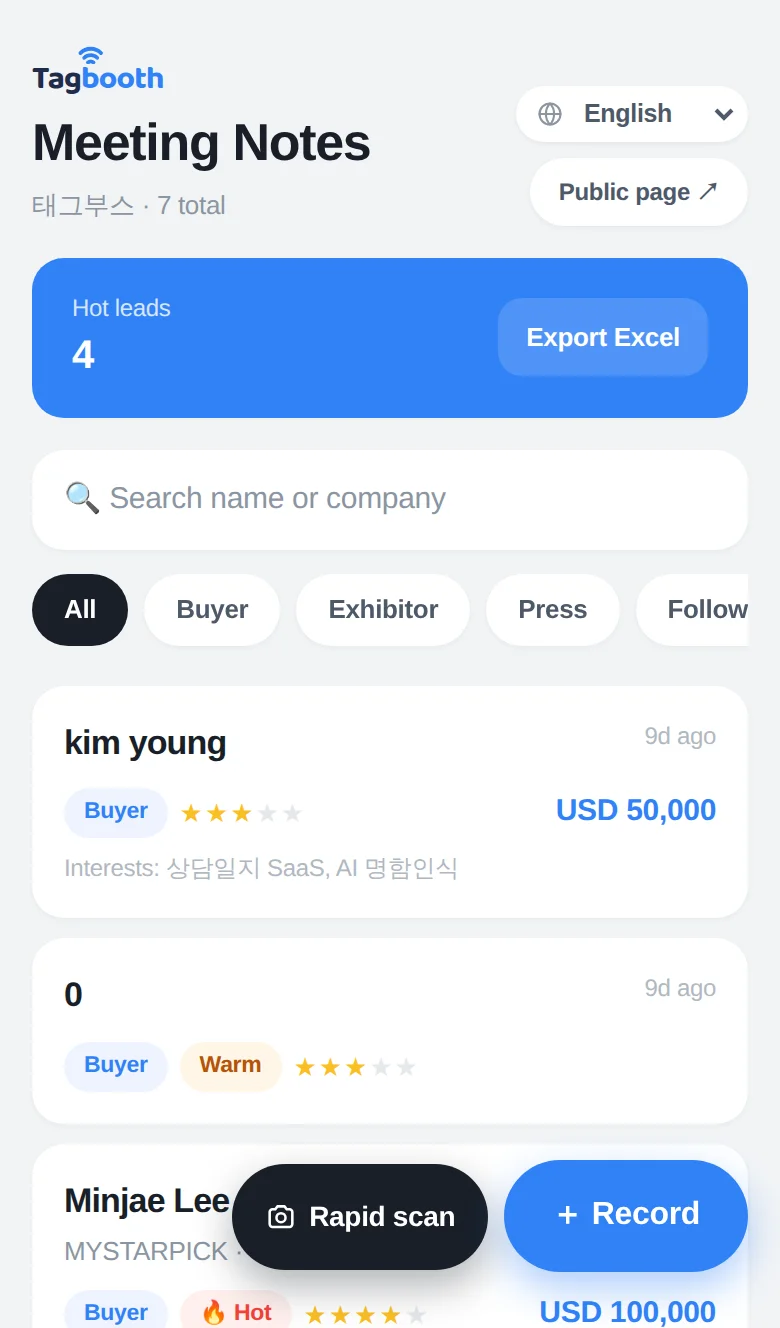
If you want one tool to carry this whole process, that's what TagBooth was built for. Scan the booth's QR/NFC tag and a 30-second meeting note opens: type, rating, product interests and follow-ups are one-tap chips, and a single photo of a business card lets AI fill in the name, company and contact details.
After the show, filter to hot leads only, or export every meeting to Excel as a ready-made follow-up list. There's nothing to install and nothing to train — interpreters use it immediately — which removes the root cause of failed follow-up: notes that never got taken. Browse the screens in the demo without an account, or see the full flow in how it works.
FAQ
When exactly should follow-up start?
For hot leads, the morning after the show. That's when the conversation is still fresh and you can beat competitors to the inbox. If the show runs several days, don't wait for the last day — close each evening by triaging that day's hot leads and contact them the next morning.
We collected hundreds of leads. Can we really reach everyone in 24 hours?
You don't reach everyone — you respect the order. Personal outreach goes to hot leads only; warm leads get a materials email grouped by product interest; cold leads move to a newsletter-style long-term track. That sequencing is only possible if temperature was recorded on site.
What if we didn't take notes at the booth?
If all you have is cards and memory, sit down with the team, rank the contacts you genuinely remember, and focus this cycle on them. Then fix the root cause for next time: make a 30-second post-meeting note — temperature, interests, one line of context — part of the process.
Should the first touch be a call or an email?
If the meeting produced a concrete promise — a quote, a sample, a meeting — a call is powerful. If that feels heavy for the relationship, start with a personalized email that references the conversation, and escalate to a call if there's no reply. Either way, what you discussed at the booth belongs in the first sentence.